
Don't miss out on any deals
Sign up for our newsletter and be the first to receive our offers, discount codes, and promotions, plus new products and special deals.
- First, our offers and promotions
- New products every week
- Exclusive discount codes
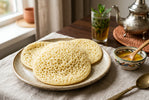
Make soft Moroccan baghrir with this basic recipe. With instructions on the batter, cooking on one side, and practical tips for when there are too few holes, sticking, or dry pancakes.
Baghrir are soft Moroccan pancakes with small holes on top. They absorb melted butter and honey beautifully. You only cook them on one side: while the bottom cooks, the characteristic holes appear on top.
With this basic recipe, you can make baghrir for breakfast, a tea time, or a cozy table with guests. While cooking, don't just look at the clock, but especially at the batter and the top of the pancake.
Baghrir, also written as beghrir, is often called the thousand-hole pancake. The batter contains fine semolina and is liquid enough to spread on its own in the pan. Unlike msemen, you do not fold baghrir and you do not cook it on two sides. The top remains soft and gets a spongy texture.
For about 10–12 small baghrir. Allow about 10 minutes for preparation, 30–45 minutes for rising, and 20–30 minutes for cooking. The yield and times depend on your pan, the portion size, and the room temperature.
You will also need a blender or hand blender, a mixing bowl, a whisk, and a flat frying pan with a good non-stick coating. A pan with a low rim makes it easier to remove. For the choice of pan, also read which pan to use for msemen, baghrir and pancakes.
Put the lukewarm water with the semolina, flour, yeast, sugar and salt in a blender. Mix for about one to two minutes until you have a smooth, pourable batter. If you use a hand blender, use a spacious, high bowl. The water should be pleasantly lukewarm, not hot.
Cover the bowl and let the batter stand for about 30–45 minutes in a draft-free place. It should develop air bubbles. In a cool kitchen, this may take longer. Then stir in the baking powder evenly. The batter should be thinner than batter for thick American pancakes. If it has become very thick, add one tablespoon of water at a time until it pours easily.
Heat the non-stick pan on a medium setting. A well-functioning non-stick coating usually does not need fat. If light greasing is necessary, wipe away excess fat: the bottom should not be covered in oil. First, cook a small test pancake to assess the heat and batter thickness.
Pour a small whiskful of batter into the center and let it spread on its own. Do not turn the pan like you would with a thin crepe. During cooking, holes appear and the wet shine disappears. Remove the baghrir from the pan as soon as the top is completely set and no longer has wet spots of batter. This often takes about one to two minutes, but varies by pan. Do not flip it over.
Place the cooked baghrir next to each other on a clean surface or cloth. Do not stack them immediately if they are still hot and moist, as they may stick together. Cook the rest and adjust the heat between batches if necessary.
This can have several causes. For the next test pancake, try changing only one thing at a time so you can see what helps.
Sticking can be due to the pan, but also to taking it out too early. First, let the top set completely and carefully loosen the edges with a suitable spatula. Do not use metal utensils on a non-stick coating.
Dry or hard baghrir may have been cooked for too long. Remove it from the pan as soon as it is cooked; a dark brown bottom is not the goal. Cover the cooled baghrir until you are ready to serve.
Serve lukewarm with melted butter and honey, either on the side or drizzled over the holes. Jam or just a little butter also goes well with it. Serve with Moroccan mint tea and combine with bread, olives and other dishes from our article about a typical Moroccan breakfast.
Let leftover baghrir steam briefly and store it covered in the refrigerator. Do not leave prepared food at room temperature unnecessarily. If you want to freeze portions, place baking paper between the cooled pancakes and package them well. After thawing, reheat them slowly in a pan on low heat, without cooking them until crispy. Add butter and honey preferably only when serving.
No, you only cook it on the bottom. Wait until the top is completely set and no longer shows wet batter.
For this basic recipe, cooking immediately after rising is the starting point. Storing it longer changes the fermentation and batter thickness. If you want to prepare ahead, it is better to cook the baghrir in advance and reheat it carefully later.
A hand blender is a handy alternative. With only a whisk, it is harder to get an evenly smooth batter; at least use fine semolina and avoid lumps.
Start with a small test pancake and take the time to get to know your pan. As soon as the batter thickness and heat work well together, you will see the holes appear on their own.


